Why Gun Safe Capacity Ratings Don't Reflect Real Storage
One of the most misleading numbers in the gun-safe industry is capacity. Consumers routinely see safes marked as "24-gun," "36-gun" or even "48-gun" safes. The assumption is simple: a safe labeled for 48 firearms must have been designed to store 48 real rifles.
That assumption is wrong.
In most cases, capacity ratings are calculated by counting how many small barrel notches can be cut into a shelf. The number reflects the shelf design, not the usable storage space for real firearms.
How Capacity Ratings Are Created
Traditional gun safes rely on shelves with evenly spaced barrel slots. Manufacturers determine capacity by counting how many slots can fit across the width of the safe interior.
Assumed Ideal Conditions
- Identical rifles
- No optics
- No lights, lasers, or accessories
- Minimal spacing between firearms
- No need for safe access paths
Under these assumptions, it is possible to assign a large capacity number to a safe. The problem is that very few rifles actually match those assumptions.
Why Real Rifles Don't Fit the Numbers
Modern firearms rarely resemble the stripped-down rifle profiles used to calculate capacity. Today's rifles commonly include optics, mounts, suppressors, lights, slings, and other accessories that increase the space each firearm requires.
Even basic scopes can prevent rifles from fitting into tightly spaced barrel slots. Accessories such as lights or vertical grips can cause firearms to collide with neighboring rifles or interior shelves.
Each firearm should have enough space to protect optics and accessories, and enough clearance to be removed cleanly. Many owners discover that a safe advertised to hold dozens of rifles can realistically store only a fraction of that number without risking damage.
Capacity numbers may look impressive on a sales label, but they rarely reflect practical storage.
The Access Problem
Even when rifles technically fit inside the safe, access becomes another issue. Traditional interiors often require firearms to be leaned against each other or stacked closely together.
Retrieving one rifle can mean moving several others first, increasing the risk of optics striking shelves, rifles scraping against each other, or accessories becoming tangled. This type of storage slows access and creates unnecessary wear on firearms and equipment.
Storage systems that require constant shifting of rifles are not designed for modern firearms.
Real Capacity Comes From Geometry
Usable firearm storage depends on more than how many rifles can be squeezed into a space. It depends on geometry, spacing, support, and access.
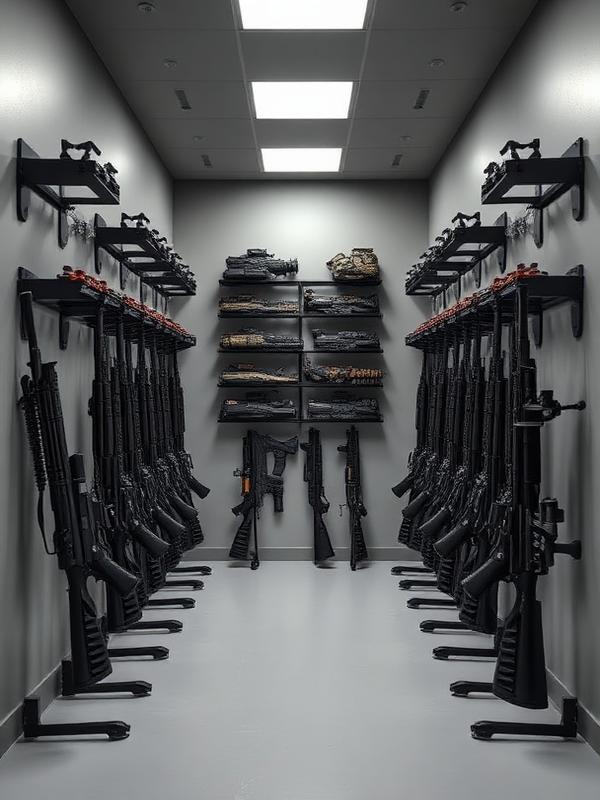
After our 18-month evaluation of U.S. Army Special Forces armories, we determined that 2 7/8" center-to-center barrel spacing is the minimum required to ensure proper storage and efficient access to modern rifles.
Each firearm should have enough space to be removed cleanly without contacting other rifles. Proper vertical support also prevents rifles from leaning, sliding, or striking interior surfaces.
When storage is designed around these principles, capacity becomes more honest and more usable. Instead of maximizing the number printed on a label, the focus shifts to storing firearms safely and efficiently.
The Bottom Line
Gun-safe capacity ratings are not calculated using real firearms. They are derived from shelf notch counts that assume unrealistic rifle profiles and no spacing requirements.
This approach creates large capacity numbers that rarely translate into practical storage once real rifles, optics, and accessories are involved.
Modern firearm storage prioritizes usable space, safe access, and proper firearm support rather than inflated numbers.
Key Takeaway
Capacity should reflect how firearms are actually stored — not how many barrel slots can fit on a shelf.